Our CSR CommitmentsCarbon Footprint
As part of our commitments to CSR, we conducted our carbon footprint assessment for the year 2023 following the Bilan Carbone® methodology, initiated by ADEME and supported by the Association for the Low Carbon Transition (ABC).
This tool allows us to measure all Greenhouse Gas (GHG) emissions generated by our activities while identifying our main emission sources, understanding their origin, and implementing concrete actions to reduce them.
This initiative is part of a drive for transparency and continuous improvement, mobilizing all our teams around a common goal: sustainably reducing our environmental impact.
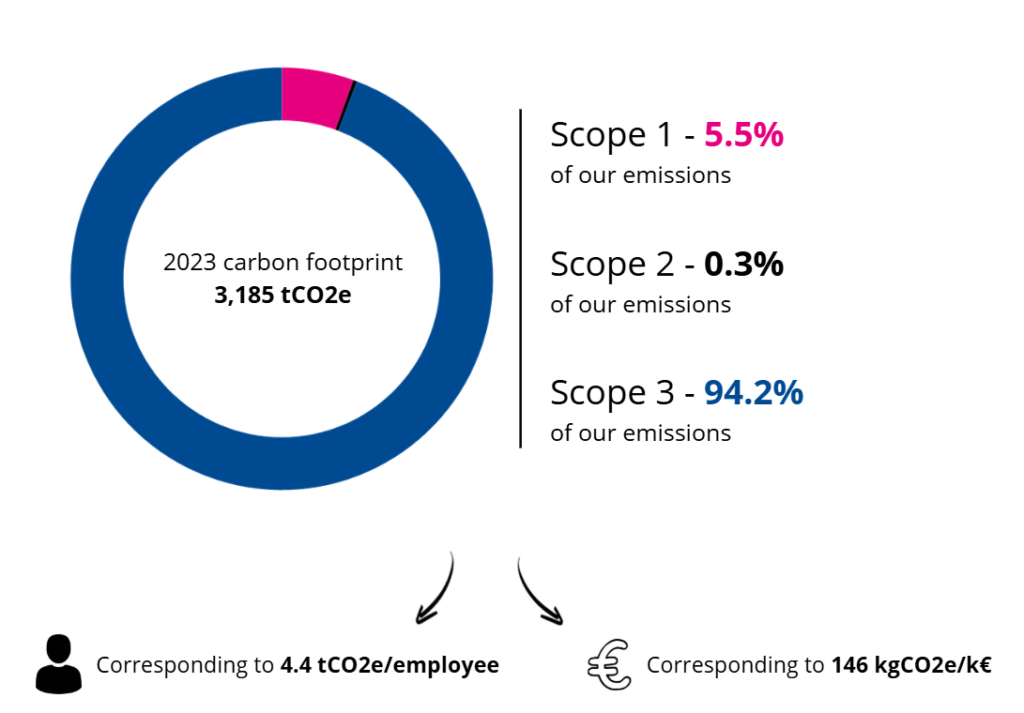
In 2023, Biowest emitted 3,185 tonnes of CO2e, distributed across 3 scopes:
What do these scopes correspond to?
Scope 1 corresponds to direct emissions occurring on our site, for example, via equipment or our vehicle fleet.
Scope 2 corresponds to indirect emissions associated with energy production, such as electricity or cooling.
Scope 3 corresponds to other indirect emissions. In this category, we find emissions linked to upstream and downstream freight, employee commuting, purchasing, digital activities, or the end-of-life of our products.
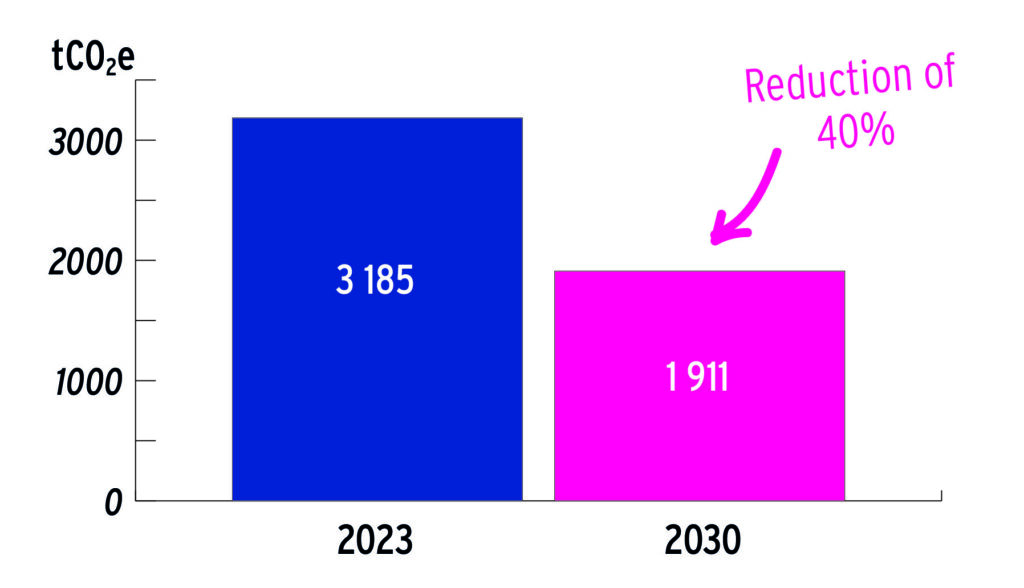
Objective 2030: reduce our CO2 emissions by 40% …
Our action plan is articulated around 5 main axes
Optimization of Transport Flows
The transportation of goods (freight) represents a significant component of our carbon footprint. Our strategy aims to drastically reduce the use of air freight, both for supply (upstream) and distribution (downstream), by prioritizing low environmental impact solutions.
Awareness: Internal Commitment and Training
To embed an environmental culture, we have implemented fun and impactful awareness initiatives (e.g., an Escape Game). The commitment is strong, as evidenced by an exceptional participation rate of 95% of employees.
Circularity and Plastic Waste Management
We are firmly committed to improving our product end-of-life management. Our goal is to achieve a total recycling rate for soiled plastic waste by 2028, thereby reducing our impact on resources.
Every action we take aims to combine economic performance, respect for the environment, ethical practices, and social progress. This vision guides our development and structures our entire supply chain.
Energy Self-Sufficiency and Green Production
Our facilities are equipped with photovoltaic panels dedicated to low-carbon electricity production. We plan to significantly increase this self-production capacity by adding new equipment.
Promotion of Sustainable Mobility
As part of our CSR approach, we actively encourage soft transport modes for home-to-work travel. The annual organization of Mobility Week is a key lever for developing more ecological commuting solutions for our teams.
This action plan will enable us to reach our goal: reducing our GHG emissions by 40% by 2030, in accordance with the National Low-Carbon Strategy (SNBC).
The SNBC itself aligns with the 2015 Paris Agreement.